
This is the actual reader, not a picture of it.
Al-Fātiḥa 1:2. Tap any of the four words to open its study card — the same card the app opens inside a surah.
“[All] praise is [due] to Allāh, Lord of the worlds -”
Tap a word to study it.
Notice ٱلْحَمْدُ carries all four properties, while لِلَّهِ splits into two pieces — a حرف جر and the اسم it governs. That split is a fragment, which is the next idea.
The gap between finishing a chapter and using it.
You finish the chapter on الإضافة knowing exactly what one is. Then you open the mushaf, and there is no exercise — just 6,236 ayahs and no way to check whether you spotted it right.
Dreami closes that loop. Read an ayah, make your own call, then tap to see whether the grammar agrees with you.
Five fragments, marked in every ayah.
The app follows Dream’s Nahw, in Dream’s own terms and order — not a general Arabic parser relabelled. Each fragment carries its definition, its two halves and the rules you were taught for it.
A حرف جر followed by an اسم. The حرف forces that اسم into the after-of (جر) status.
A حرف نصب (إنّ and her sisters) followed by an اسم, which it forces into the detail (نصب) status.
Two أسماء joined to express belonging. Rearrange to find the hidden 'of': 'my book' → 'book of mine'.
An اسم followed by a word describing it. In Arabic the adjective comes AFTER the noun, unlike English.
A pointing word (this / that / these / those) followed by the thing it points at.
Connectors (حروف العطف) get a card of their own. Dream teaches them as what joins fragments rather than as one of the five, so the app shows the status running through the chain instead of asserting it.
The mushaf’s page breaks, in real text.
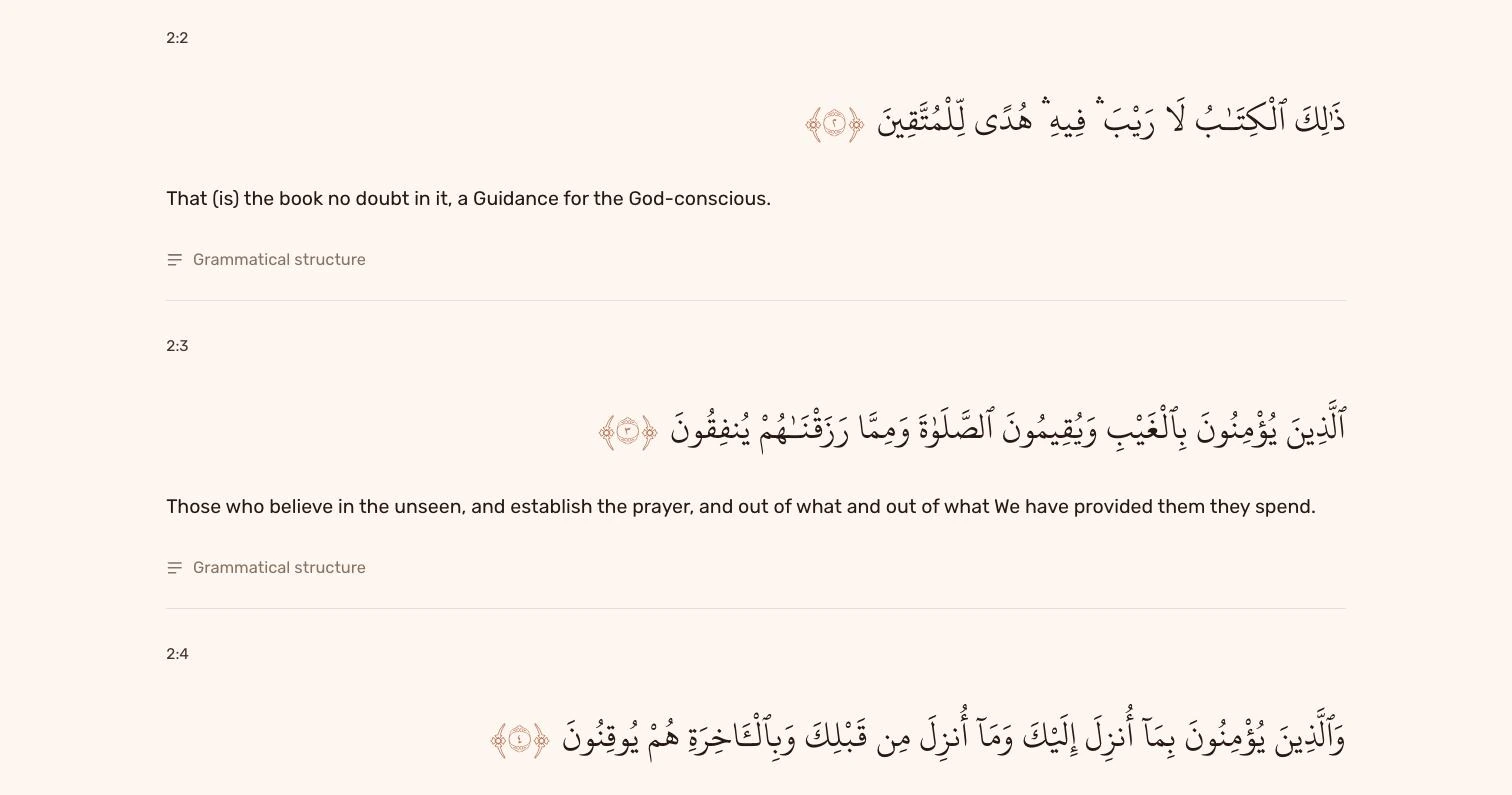
Verse by verse, each ayah with its translation and a “Grammatical structure” action. Built for study.
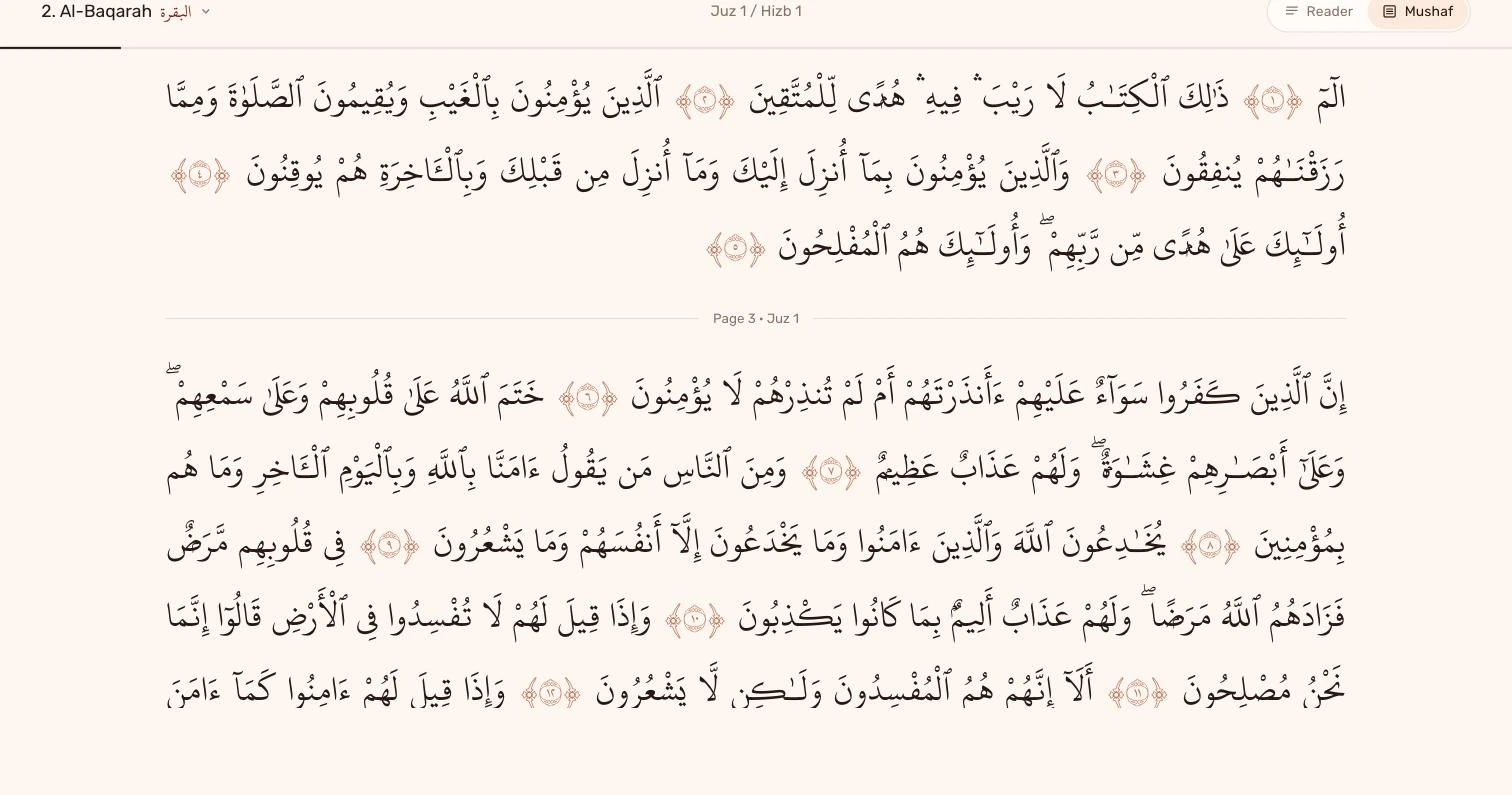
Continuous text broken at the exact Madani page boundaries, each page labelled with its juz. Built for reading at length.
Most apps get mushaf-accurate pages by using QCF page fonts, where each word is a single atomic glyph. That makes per-word tapping and root search impossible. Dreami takes the mushaf’s layout and sets it in an ordinary typeface, so every word on the page is still real, selectable, tappable text.

Early, and built one concept at a time.
The whole Quran is imported and annotated. What grows now is the grammar itself — each concept, once built, is marked across every ayah at once.
Dream’s Nahw is being implemented a chapter at a time, and the corpus grows with it. Whatever the app can already read, it marks on every ayah of every surah it has imported — and more lands as it is built.